




Research Disclaimer: This article is intended for educational and informational purposes regarding the chemical and biochemical properties of research compounds. All information is provided strictly in a scientific context. This content does not constitute medical advice, nor does it promote the use of any compound for human or veterinary application. All compounds referenced are for laboratory research use only.
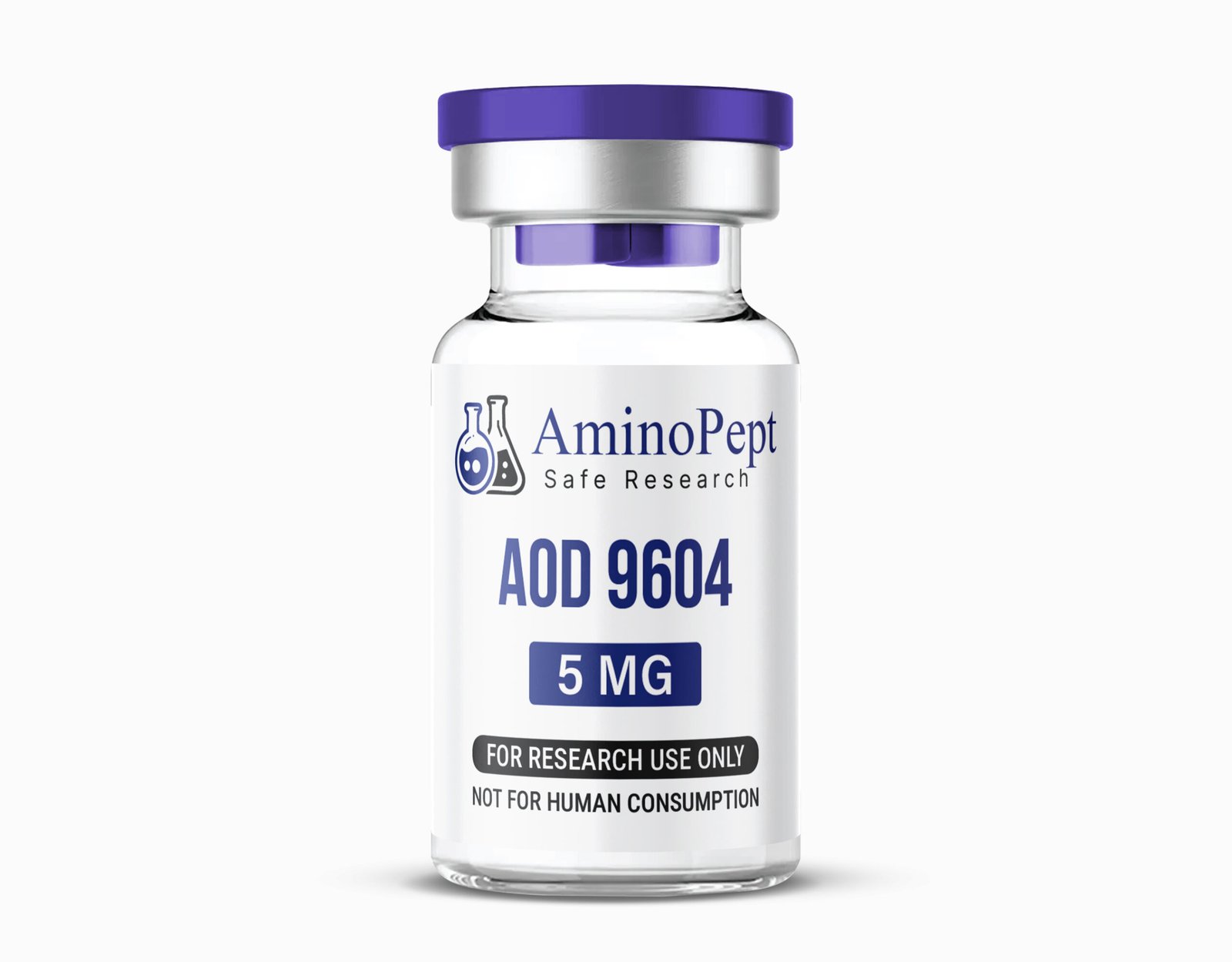
AOD-9604 is a synthetic peptide fragment derived from the C-terminus of Human Growth Hormone (HGH). Originally developed as part of research into the metabolic properties of growth hormone, it has since become a widely studied compound in biochemical and molecular research settings. Unlike the full HGH molecule, AOD-9604 is valued in research for its selective interaction with lipid metabolism pathways without engaging the primary growth-promoting mechanisms of the parent hormone.
Background and Discovery
The development of AOD-9604 originated from research conducted at Monash University in Australia during the 1990s. Scientists investigating the biological activity of Human Growth Hormone sought to isolate the region of the molecule responsible for its effects on fat metabolism. Through systematic fragmentation and structural analysis, the C-terminal fragment corresponding to amino acids 177–191 was identified as exhibiting distinct lipolytic activity in experimental models.
The designation ‘AOD’ refers to ‘Anti-Obesity Drug’, reflecting the original research direction, while ‘9604’ is a reference identifier used by the research team. A tyrosine residue was added to the N-terminus of the native fragment to stabilise the peptide structure, resulting in the final research compound known as AOD-9604 (Tyr-hGH Fragment 177–191).
Since its initial characterisation, AOD-9604 has been the subject of numerous in vitro and in vivo research studies exploring its biochemical properties, receptor interactions, and metabolic effects in controlled laboratory environments.
Molecular Structure and Chemical Profile
AOD-9604 is a peptide consisting of 16 amino acid residues, including the added N-terminal tyrosine. Its defined sequence and relatively small molecular size make it suitable for precise analytical investigation and experimental replication in laboratory settings.
| Specification | Data |
| Common Name | AOD-9604 |
| Full Name | Tyr-hGH Fragment 177–191 |
| CAS Number | 221231-10-3 |
| Molecular Formula | C78H123N23O23S2 |
| Molecular Weight | 1815.1 g/mol |
| Amino Acid Sequence | Tyr-Leu-Arg-Ile-Val-Gln-Cys-Arg-Ser-Val-Glu-Gly-Ser-Cys-Gly-Phe |
| Appearance | White to off-white lyophilized powder |
| Solubility | Soluble in bacteriostatic water or sterile water |
| Storage (Lyophilized) | -20°C, stable up to 24 months |
| Storage (Reconstituted) | +4°C, use within 4 weeks |
| Purity (Research Grade) | >99% by HPLC |
Structural Relationship to Human Growth Hormone
Human Growth Hormone is a 191-amino acid polypeptide produced by the anterior pituitary gland. Research has mapped distinct functional domains within the full HGH molecule, with different regions associated with different biological activities. The N-terminal region of HGH is predominantly associated with anabolic and growth-promoting effects, including binding to the GH receptor and stimulating IGF-1 secretion.
The C-terminal fragment—from which AOD-9604 is derived—has been identified in research as a structurally distinct region with separable biological activity. In vitro and in vivo studies have consistently noted that AOD-9604 does not appear to bind to the GH receptor with meaningful affinity, and does not induce measurable IGF-1 secretion in experimental models. This functional separation makes it a useful research tool for studying the metabolic aspects of growth hormone biology in isolation from its anabolic effects.
Research Findings: Lipid Metabolism
The primary area of scientific investigation for AOD-9604 relates to its effects on lipid metabolism in experimental systems. Studies conducted in in vitro and animal model settings have reported the following observations:
Lipolytic activity: AOD-9604 has been observed to stimulate lipolysis—the breakdown of stored triglycerides into free fatty acids—in adipocyte cell lines and animal adipose tissue preparations. This activity appears to involve beta-adrenergic receptor signalling pathways, consistent with the broader mechanisms of lipid mobilisation observed in response to growth hormone administration.
Anti-lipogenic effects: In the same experimental systems, AOD-9604 has been shown to inhibit lipogenesis—the conversion of non-fat dietary substrates into stored fat. Researchers have suggested that this dual action on lipolysis and lipogenesis may contribute to the net metabolic effects observed in animal studies.
Lack of insulin-related activity: Multiple research studies have confirmed that, unlike the full HGH molecule, AOD-9604 does not appear to induce insulin resistance or alter glucose metabolism in standard experimental models, making it a useful tool for studying fat metabolism independently of insulin sensitivity effects.
Research Findings: Connective Tissue and Cartilage
More recent laboratory investigations have expanded the research profile of AOD-9604 to include potential effects on connective tissue. In vitro studies using chondrocyte cell cultures and animal model systems have investigated whether AOD-9604 may influence the synthesis of extracellular matrix components, including collagen and proteoglycans.
Some studies have reported enhanced collagen synthesis and reduced degradation markers in cartilage tissue preparations treated with AOD-9604, though findings remain preliminary and have not been independently replicated at a scale that would allow firm conclusions. This line of research continues to be explored in academic and preclinical settings.
Laboratory Handling and Reconstitution
AOD-9604 is supplied as a lyophilized (freeze-dried) powder, which requires reconstitution prior to use in experimental protocols. Standard laboratory practice involves the use of bacteriostatic water or sterile water for reconstitution, with the specific solvent choice depending on the intended duration of use and experimental requirements.
For reconstitution, sterile technique should be observed throughout. The lyophilized powder should be allowed to reach room temperature before reconstitution to minimise condensation. Solvent should be introduced slowly along the vial wall rather than directly onto the powder to avoid agitation and potential structural degradation.
Reconstituted solutions should be stored at +4°C and used within four weeks. Repeated freeze-thaw cycles are not recommended as they may compromise peptide integrity. Lyophilized stock should be stored at -20°C in the original sealed vial.
Analytical Verification
Research-grade AOD-9604 is typically verified through two primary analytical methods: High-Performance Liquid Chromatography (HPLC) for purity assessment, and mass spectrometry for molecular weight and sequence confirmation. HPLC analysis allows precise quantification of the target peptide relative to potential impurities or degradation products, while mass spectrometry provides structural confirmation of the intact peptide.
Research-grade supplies carrying >99% HPLC-verified purity represent the standard for experimental use, as impurities or degradation products can significantly confound experimental results, particularly in sensitive cell-based assays.
Research Context and Literature
AOD-9604 has appeared in peer-reviewed literature primarily in the context of metabolic research, with publications examining its lipolytic properties in adipose tissue models, its interaction with adrenergic signalling pathways, and its structural relationship to the parent HGH molecule. A significant volume of early research was conducted under commercial development programmes, with subsequent academic interest focused on the mechanistic basis of its observed metabolic effects.
The compound has not been approved for use as a medicine or therapeutic agent in any jurisdiction. All existing research data derives from preclinical laboratory and animal model settings. Researchers utilising AOD-9604 should consult the primary literature directly for experimental context and should treat all prior findings as hypothesis-generating rather than conclusive.
Note: All content in this article is provided for scientific and educational reference only. AOD-9604 is available from Aminopept for laboratory research use only and is not intended for human or veterinary application.
——————————————————————————————————-
AOD-9604 is available in research-grade, lyophilized form from the Aminopept research catalogue. Supplied for laboratory and in-vitro research use only.
→ View AOD-9604 in the research catalogue
Leave a Reply