




Research Disclaimer: This article is intended for educational and informational purposes regarding the chemical and biochemical properties of research compounds. All information is provided strictly in a scientific context. This content does not constitute medical advice, nor does it promote the use of any compound for human or veterinary application. All compounds referenced are for laboratory research use only.
In research literature and supplier catalogues, the terms AOD-9604 and HGH Fragment 176-191 appear with enough regularity — and enough conflation — that clarifying the structural relationship between them is a genuine scientific necessity. These are not interchangeable designations for the same compound. They differ in sequence, molecular weight, and N-terminal chemistry, and those differences have implications for how each peptide behaves in experimental systems.
This article provides a precise structural comparison intended for researchers working with either compound, sourcing research-grade material, or reviewing the literature where both appear.
Origins: Both Derived from Human Growth Hormone
Both AOD-9604 and HGH Fragment 176-191 are derived from the C-terminal region of human growth hormone (hGH), a 191-amino acid pituitary peptide. The lipolytic activity of hGH — its ability to stimulate fat cell breakdown — was mapped in early research to this C-terminal domain, leading to the development of isolated fragments as research tools.
The rationale for working with a C-terminal fragment rather than the full hGH molecule was to isolate the lipolytic activity without the insulin-resistance and IGF-1-elevating properties associated with the full hormone. The N-terminal domain of hGH is responsible for binding the GH receptor and initiating the anabolic and diabetogenic signalling cascade. The C-terminal fragment, by contrast, does not bind the GH receptor with meaningful affinity.
Understanding this context makes the structural differences between the two fragments more meaningful — even small changes at the N-terminus of these fragments alter how they interact with their molecular environment.
HGH Fragment 176-191: The Direct Sequence Excerpt
HGH Fragment 176-191 is exactly what its name implies: the amino acid sequence spanning positions 176 through 191 of the native human growth hormone sequence. It contains 16 residues and has a free N-terminal amino group (an unmodified amine at the N-terminus).
| Parameter | Detail |
| Common name | HGH Fragment 176-191 |
| CAS Number | 177036-94-1 |
| Sequence (single-letter) | SLTKLFDNAMLRAHRL |
| Residue count | 16 amino acids |
| N-terminus | Free amine (H2N-) |
| C-terminus | Amide (-NH2) in the native hGH context; varies by synthesis |
| Molecular weight | ~1815.1 Da |
| Molecular formula | C78H123N23O23S2 |
| Disulfide bond | Present between Cys182 and Cys189 in native hGH context |
The disulfide bond between residues 182 and 189 of native hGH corresponds to residues 7 and 14 within the 176-191 fragment. This internal disulfide creates a constrained loop structure that is important for the fragment’s biological activity — research has indicated that the cyclic form (with intact disulfide) is significantly more active in lipolysis assays than the linear reduced form.
AOD-9604: The Modified Version
AOD-9604 (Anti-Obesity Drug 9604) was developed at Monash University in the 1990s during systematic research into the lipolytic domain of hGH. It differs from HGH Fragment 176-191 in one specific and deliberate way: an additional tyrosine residue has been added to the N-terminus.
| Parameter | Detail |
| Common name | AOD-9604 |
| Alternative name | Tyr-hGH Fragment 177-191 |
| CAS Number | 221231-10-3 |
| Sequence (single-letter) | Y-SLTKLFDNAMLRAHRL (Tyr prepended) |
| Residue count | 17 amino acids (16 + N-terminal Tyr) |
| N-terminus | Tyrosine residue (free amine on Tyr) |
| C-terminus | Amide |
| Molecular weight | ~1952.3 Da |
| Molecular formula | C87H135N23O24S2 |
| Disulfide bond | Present — same Cys-Cys bond as in parent fragment |
The addition of the N-terminal tyrosine has two practical consequences. First, it shifts the numbering: the fragment now begins at position 177 of the native hGH sequence (because position 176 has been replaced by the tyrosine). This is why AOD-9604 is sometimes described as Tyr-hGH Fragment 177-191 rather than Fragment 176-191. Second, tyrosine at the N-terminus modifies the electrochemical properties of the peptide, particularly its behaviour in acidic conditions, and may influence bioavailability in oral administration contexts — which was relevant to the Monash University clinical programme that explored oral AOD-9604 dosing.
Direct Structural Comparison
| Property | HGH Fragment 176-191 | AOD-9604 |
| Residue count | 16 | 17 |
| CAS number | 177036-94-1 | 221231-10-3 |
| Molecular weight | ~1815.1 Da | ~1952.3 Da |
| N-terminal residue | Ser (Serine, position 176) | Tyr (Tyrosine, added) |
| Molecular formula | C78H123N23O23S2 | C87H135N23O24S2 |
| Disulfide bond | Yes (Cys182–Cys189) | Yes (same bond) |
| C-terminus | Variable by synthesis spec | Amide |
| hGH positions covered | 176–191 | 177–191 + N-Tyr |
| GH receptor binding | Not significant | Not significant |
| Beta-3 pathway activity | Yes | Yes |
Why the N-Terminal Tyrosine Matters
The N-terminal tyrosine in AOD-9604 is not a trivial modification. Tyrosine carries a phenolic hydroxyl group on its side chain that is chemically versatile — it can participate in hydrogen bonding, is susceptible to phosphorylation, and influences the hydrophilicity profile of the molecule’s N-terminal region.
From a synthetic chemistry perspective, an N-terminal tyrosine also facilitates radiolabelling. The phenolic ring of tyrosine can be iodinated (using Bolton-Hunter or chloramine-T methods) to produce radioiodinated peptides for receptor binding assays and pharmacokinetic studies. This is a practical research advantage that may have contributed to the choice of tyrosine as the N-terminal addition in AOD-9604’s development.
From a pharmacological perspective, the tyrosine modification was associated with improved solubility and stability in the acidic environment of the gastrointestinal tract, which was important for the oral dosing route investigated in Monash University’s clinical trials.
Receptor Interactions: What the Structural Difference Means
Both fragments retain the disulfide-constrained loop that is believed to be the pharmacophore for their metabolic activity. Neither fragment binds the canonical GH receptor (GHR) with meaningful affinity — the GHR binding domain is located in the N-terminal region of native hGH, not in the C-terminal fragment region. This is what distinguishes both compounds from full hGH and is central to their research profile.
The proposed mechanism of action for both compounds involves interaction with beta-3 adrenergic receptors in adipocytes and possibly direct activation of intracellular lipase pathways. The structural evidence for this mechanism remains primarily from in vitro and animal model data. Whether the N-terminal tyrosine of AOD-9604 alters its affinity for these adipocyte targets relative to HGH Fragment 176-191 has not been definitively established in comparative binding studies.
Sourcing and Identification Considerations
For researchers sourcing either compound, the CAS number is the most reliable identifier and should always be verified against the certificate of analysis. CAS 221231-10-3 identifies AOD-9604 specifically. CAS 177036-94-1 identifies HGH Fragment 176-191. Mass spectrometry confirmation of molecular weight is the standard method for distinguishing between the two, given the approximately 137 Da difference (the mass of the added tyrosine residue).
HPLC purity data alone cannot distinguish AOD-9604 from HGH Fragment 176-191 — a peptide can show >99% purity on HPLC while still being the wrong compound if the synthesis used the wrong starting sequence. Mass spectrometry is required for sequence confirmation.
Both compounds are available in lyophilized form from research-grade suppliers and require reconstitution with bacteriostatic water prior to use. Storage protocols are identical: -20°C for lyophilized material, +4°C for reconstituted solution, used within 28 days of reconstitution.
ℹ️ This article is written for laboratory researchers working with these compounds in a scientific context. AOD-9604 and HGH Fragment 176-191 are research compounds supplied for in vitro and experimental use only. They are not approved pharmaceutical products.
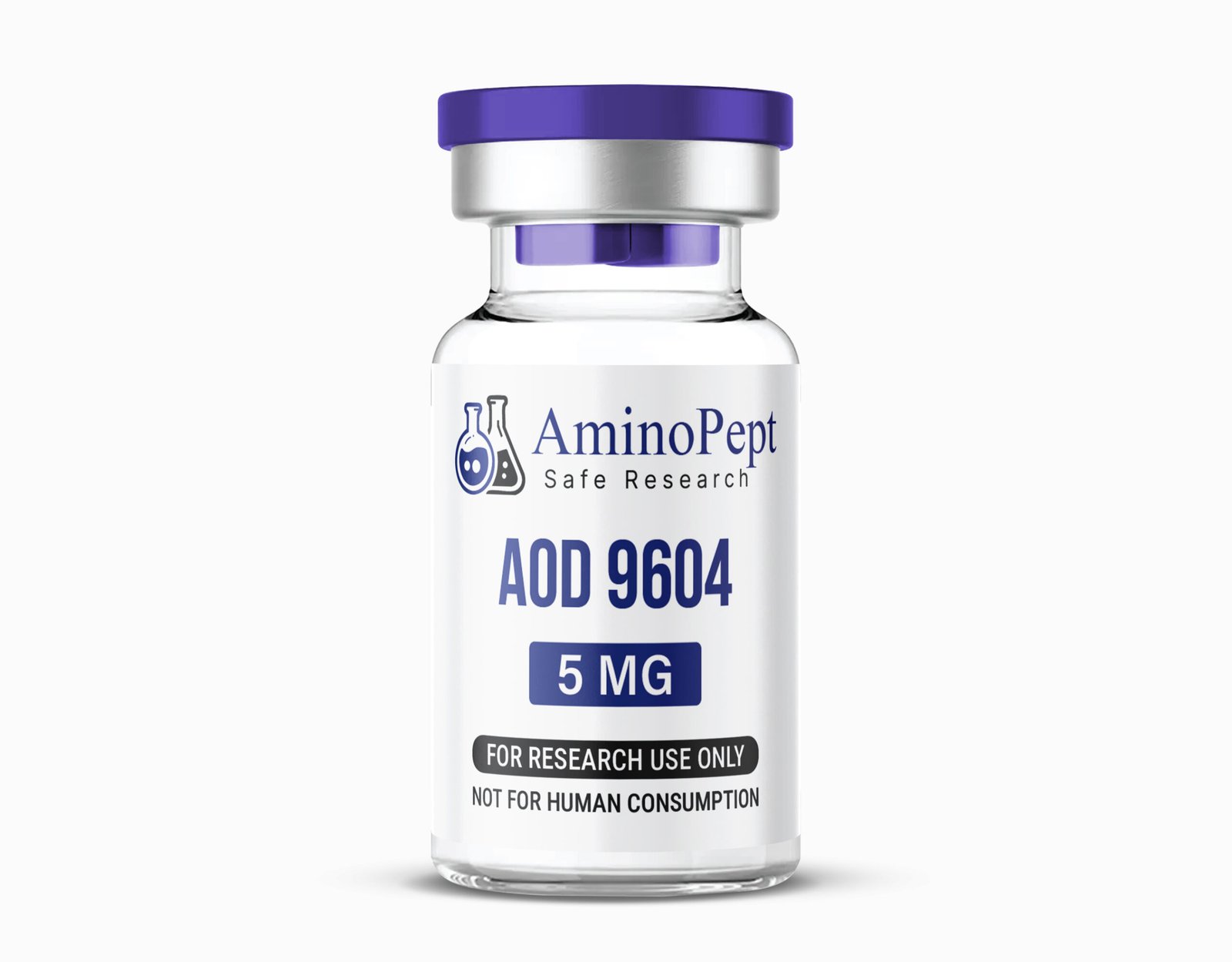
AOD-9604 is available in research-grade, lyophilized form from the Aminopept research catalogue. Supplied for laboratory and in-vitro research use only.
→ View AOD-9604 in the research catalogue
Leave a Reply